
The alley is free with no tickets or mandatory guides required. This 68-centimeter-wide passage in Guanajuato’s historic center charges nothing for entry, but confusion about costs persists because of optional services, guided tours, and deliberate misinformation from vendors who benefit from tourists thinking otherwise.
More about Callejon del Beso:
- Callejon del Beso Tours
- The Alley of the Kiss (Callejon del Beso): Everything You Need to Know About Guanajuato’s Most Romantic Landmark
How Callejón del Beso Became a Must-Visit Destination
Twenty years ago, this narrow passage was just another unremarkable alley that locals knew about. Guanajuato became a UNESCO World Heritage site in 1988, but the alley hadn’t yet transformed into an organized attraction. Social media changed everything. Instagram turned a simple colonial architectural quirk into a romantic pilgrimage site.
The transformation happened gradually. First came travel bloggers sharing photos of couples kissing between balconies. Then tour companies added the alley to their routes. Finally, photographers and souvenir vendors established permanent stations. The legend of seven years of good luck for couples kissing on the third step spread faster than any marketing campaign could achieve.

Callejón del Beso Alley View | is Callejón del Beso free to enter
What could have stayed a quiet local landmark instead became one of Mexico’s most photographed spots. The alley went from maybe a dozen daily visitors to hundreds, sometimes thousands on peak days. This shift created an ecosystem where free access coexists with aggressive monetization attempts.
Is Callejón del Beso Free to Enter? Breaking Down the Facts
The question travelers ask most often is answered simply: is Callejón del Beso free to enter? Yes, completely. You’ll pay nothing to walk through the passage itself. The space remains public property, open 24 hours daily, accessible to anyone who wants to climb the steps. No gates, no turnstiles, no admission booth, no entrance fee whatsoever.
Photographers offer kiss photos for 50-100 pesos ($3-6 USD at current exchange rates), while souvenir vendors sell magnets, postcards, and replicas for 30-150 pesos.
These are optional purchases. The photographers sometimes position themselves to create the impression you must pay for balcony access. You don’t.
Cash works best here. Vendors rarely accept cards. Bring small bills—100 peso notes or smaller—because change can be scarce during busy periods.
Comparison: Independent Visit vs. Guided Tour
The Callejoneada tours include the alley as one stop on a musical walking tour through Guanajuato’s historic center. These 70-minute experiences feature live Spanish music by the Estudiantina, a dance performance, and guided storytelling. That’s a different product than just visiting the alley independently. You can learn more about Guanajuato’s cultural tours through the official tourism website.
“Photographers will tell you the balconies are private property requiring payment. This is false. The balconies are indeed private, but standing on the public steps and taking photos is completely legal. Politely decline if you’re not interested in professional photos. Don’t let anyone pressure you into paying for ‘access’ you already have for free.”
Three Costly Mistakes Travelers Make
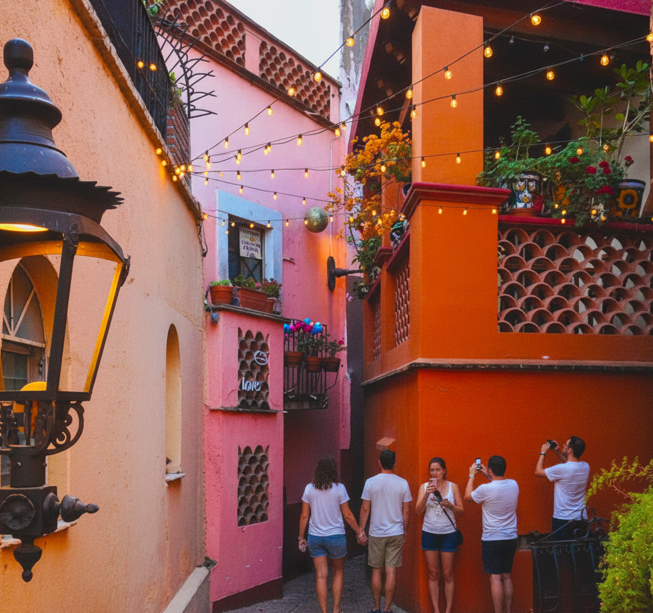
Evening at Callejón del Beso | how much does it cost to take a photo on the balcony at Callejón del Beso
Mistake #1: Believing you need a ticket or guide
Travelers see organized tour groups with uniformed guides and assume official entry requires payment. This belief stems from experiences at other Mexican landmarks where UNESCO sites or archaeological zones do charge admission fees.
The mechanism that creates disappointment: You spend 30 minutes online searching for “Callejón del Beso tickets” or asking hotel concierges about admission requirements. You might even pay a third-party booking site a markup for tour packages when all you wanted was to see the alley.
Price of the mistake: You waste time researching non-existent requirements and potentially spend $15-30 on a tour when you only wanted a 10-minute photo stop. If you’re on a tight schedule, you might skip the attraction entirely thinking it requires complex planning or significant cost. Lost opportunity: missing an iconic photo spot because you believed incorrect information.
Mistake #2: Scheduling three hours for a 20-meter passage
The alley takes 15 minutes to see, but tourists who read about this “famous romantic landmark” expect complexity—multiple viewpoints, interpretive displays, and surrounding gardens—so they schedule “Callejón del Beso: 9 AM – 12 PM.”
Travel blogs emphasize the alley’s cultural importance without clarifying its actual physical size. You imagine something comparable to a small museum or park.
Price of the mistake: Your itinerary shows three wasted hours. You end up in overpriced tourist-area cafes, paying 180-250 pesos ($10-14 USD) for mediocre coffee, filling time before your next planned stop. Three hours is enough time to visit the Diego Rivera Museum, climb to El Pípila viewpoint, and explore two additional neighborhoods. By overestimating how long you need here, you sacrifice other experiences in a city packed with worthwhile attractions.
Mistake #3: Visiting without understanding the architectural context
You arrive, take the obligatory kissing photo, then leave confused about why this specific narrow alley matters when Guanajuato has dozens of similar passages.
This happens because most visitors skip the surrounding area. The alley makes sense only when you understand Guanajuato’s unique topography—a city built in a narrow mountain valley where Spanish colonial builders created vertical architecture out of necessity, not design.
Price of the mistake: You don’t grasp why the alley exists or what makes it representative rather than unique. You photograph one spot without seeing the pattern. You get a shallow experience, no deeper place-connection. Think of it like visiting the Leaning Tower of Pisa without understanding why it leans. You get a photo but miss the story that makes the photo meaningful.
Better approach: Walk 15 minutes around Plaza de los Angeles. Notice how many buildings have balconies within arm’s reach. Understanding that wealthy miners built wherever they found level ground explains why romance could unfold across a 68-centimeter gap. Five extra minutes of context transforms your visit from photo-op to cultural insight.
Viewing from Both Sides: When Callejón del Beso Disappoints
This alley genuinely works for couples seeking romantic photo opportunities, history enthusiasts interested in colonial architecture, and cultural travelers who appreciate the blending of legend and place. But it’s not universal.
Tuesday or Wednesday mornings work best, while weekends and Mexican holidays like Valentine’s Day and Día de Muertos create waiting lines. If you hate crowds, this becomes miserable. Imagine standing in a narrow stairwell, surrounded by 40 other tourists, each couple waiting their turn to pose on the famous third step while photographers compete for position and souvenir sellers call out prices. The romantic atmosphere vanishes.
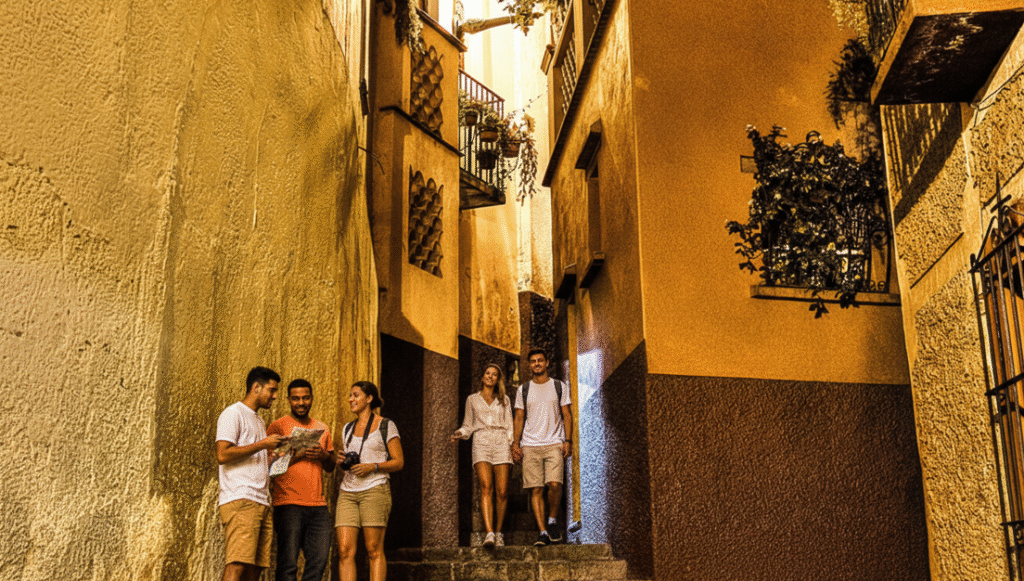
Exploring Callejón del Beso | official price Callejón del Beso
The compromise here is clear. Choose peak times and you’ll wait. You might spend 45 minutes for a 30-second photo. The alternative—visiting during off-peak hours—means fewer people but also less energy. Part of the appeal for some visitors is the communal excitement. Arrive at 7 AM to an empty alley and you get privacy but lose the buzz.
Solo travelers might feel awkward. The entire experience centers on couples. The legend specifically promises seven years of happiness to couples who kiss on the third step. While nobody will stop solo visitors from exploring, the atmosphere implicitly excludes you from the main ritual. If you’re traveling alone and sensitive to couple-focused environments, this can feel uncomfortable.
Accessibility presents challenges. The alley consists entirely of steep, uneven stone steps. Wheelchair access is impossible. Limited mobility makes this difficult or dangerous, especially when crowded. The steps get slippery during rain. No handrails exist for support.
How Much Does It Cost to Take a Photo on the Balcony at Callejón del Beso?
Many visitors wonder how much does it cost to take a photo on the balcony at Callejón del Beso. Professional photographers stationed at the site typically charge 50-100 pesos ($3-6 USD) for digital copies of posed kissing photos. This fee is entirely optional—you can take your own photos with your phone or camera at no charge.
The photographers don’t own the balconies or control access to them. They’re simply offering a service. You’re paying for their equipment, editing, and instant delivery of professional-quality images, not for permission to stand in the space.
Negotiate before agreeing to any photo package. Ask exactly what you’ll receive—number of photos, delivery method (WhatsApp, email, USB), editing included, and timeline for receiving images. Some photographers offer printed photos on-site for 80-150 pesos, while others provide only digital files.
If you prefer taking your own photos, bring a tripod or use your phone’s timer function. The lighting works best between 9-11 AM when natural light illuminates the alley without harsh shadows. Evening visits after 6 PM offer softer light but require higher ISO settings or flash.
The Real Rules: What You Can and Cannot Do
The public right-of-way includes the steps and passage. You can walk through, stand on any step including the famous third step, take photos, and stay as long as you want during any hour. No permission required.
The private property includes the actual houses and their balconies. You cannot enter the buildings without permission. Some residents occasionally allow photographers to set up inside for a fee, but this is optional commercial activity, not a requirement for visiting.
Respectful behavior matters here. Don’t write on walls, leave trash, or damage property. The balcony flowers you see in photos belong to residents. Don’t touch or take them. Keep noise reasonable—people live here. Early morning and late evening visits should be quieter out of courtesy to neighbors.
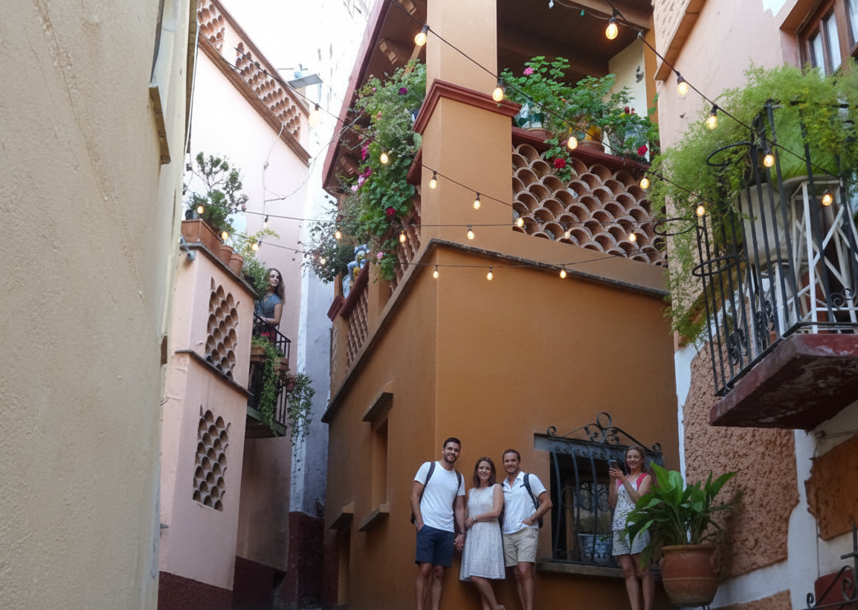
Callejón del Beso Photo Spot | how much does it cost to take a photo on the balcony at Callejón del Beso
Photography is permitted throughout the public areas. You own any photos you take yourself. Street vendors require no interaction unless you want to purchase something. A simple “no gracias” works. Repeated offers happen during busy times. Stay polite but firm. If someone claims you need to pay them for “permission” to be in the alley, this is false. Walk away.
The legend about seven years of good or bad luck is folklore, not rules. Tradition says couples who kiss on the third step receive seven years of happiness, while those who pass through without kissing face seven years of bad luck. You won’t face any consequences beyond superstition for ignoring this. Solo travelers and those who prefer not to participate should feel free to skip the kissing tradition entirely.
Hidden Factors That Affect Your Experience
October through May brings a dry season with temperatures 7-28°C (45-82°F), minimal rain, and easy planning. June through September means the rainy season with afternoon showers, fewer tourists, and 30-50% lower hotel rates. The alley remains accessible year-round, but wet steps become slippery and potentially dangerous.
Time of day changes the character completely. Morning light hits the alley around 9-11 AM, ideal for photography. Evening visits between 6-7 PM can be quieter—tourists are usually at dinner. Night visits offer different appeal with street lighting creating a moody atmosphere, though safety considerations apply for dark alleyways.
Language rarely creates problems. The legend and basic information are available in English through guidebooks, apps, and multilingual vendors. Callejoneada tours operate primarily in Spanish, but the visual and musical elements help even those with limited Spanish enjoy the experience.
Physical demands are minimal for most visitors. You’ll climb approximately 15 steep steps, requiring basic mobility. The altitude in Guanajuato sits at 2,000 meters (6,560 feet), which some visitors notice as mild breathlessness during physical activity. This is normal and doesn’t typically cause issues for healthy adults.
Real scenario: Budget traveler avoiding unnecessary costs
Sarah planned two days in Guanajuato with a daily budget of $40 including accommodation. She read online that the attraction was “free” but saw tour packages ranging from $15-30. Confused, she almost skipped it thinking the free information was outdated.
- What she did: Walked directly to Plaza de los Angeles around 8 AM on a Wednesday. Followed signs to the alley. Spent 20 minutes exploring, taking her own photos with a phone tripod timer. Declined photographer offers politely. Bought one small souvenir magnet for 30 pesos ($1.75).
- Result: Visited the alley spending only $1.75, saved $15-30 she would have spent on an unnecessary tour, had time to visit three other Guanajuato attractions that same morning, and still got excellent photos without crowds. Total time including finding the location: 45 minutes. Budget impact: negligible.
Planning Your Visit: The Practical Approach
Getting there: From Jardín de la Unión (the main plaza), walk to Plaza de los Angeles on Avenida Juárez. Walk about 40 meters up Callejón del Patrocinio to see the tiny alley on your left. Total walking time from central Guanajuato: 8-12 minutes. The city is compact and walkable. Taxis are unnecessary unless you have mobility limitations.
Optimal timing strategy: Tuesday or Wednesday before 9 AM provides empty frames, while weekend crowds turn the alley into a queue and Valentine’s week is impossible. Alternative quiet times include 7-8 PM on weeknights after dinner rushes but before evening tour groups arrive.
What to bring:
- Camera or smartphone with adequate battery
- Small bills (20, 50, 100 peso notes) if you plan optional purchases
- Comfortable walking shoes with grip for stone steps
- Water bottle—Guanajuato’s altitude and walking create thirst
- Light jacket for evening visits when temperature drops
What to skip:
- Expensive tour bookings just for alley access
- Heavy camera equipment—phone cameras work fine in natural light
- Formal attire—this is a casual attraction involving climbing steps
- Large groups—narrow space makes groups of 6+ unwieldy
Combined itinerary: Efficient travelers pair Callejón del Beso with nearby attractions within a two-hour walking loop. Start at the alley early (8-9 AM), continue to Museo Casa Diego Rivera (15-minute walk, opens at 10 AM), then climb to Monumento al Pípila (20-minute uphill walk) for panoramic city views. Total cost including alley: approximately $5 for museum entry plus optional alley purchases.
“The best photos aren’t from the third step where everyone goes. Stand at the alley entrance looking up—you’ll capture the compressed architecture and balconies without people blocking your shot. Also, 20 meters past the famous spot, the alley continues with equally photogenic colonial details and zero tourists. Explore beyond the main attraction.”
What’s the Official Price for Callejón del Beso: Guided Tours Explained
When researching the official price Callejón del Beso, many travelers encounter confusion between the free alley access and paid tour options. The landmark itself has no official entrance fee established by the government or tourism board. However, commercial tour operators offer Callejoneada experiences that include the alley as part of a broader cultural package.
Independent visits work for budget travelers, quick stops during city explorations, photographers wanting creative control, and anyone with limited time who specifically wants to see just this one landmark.
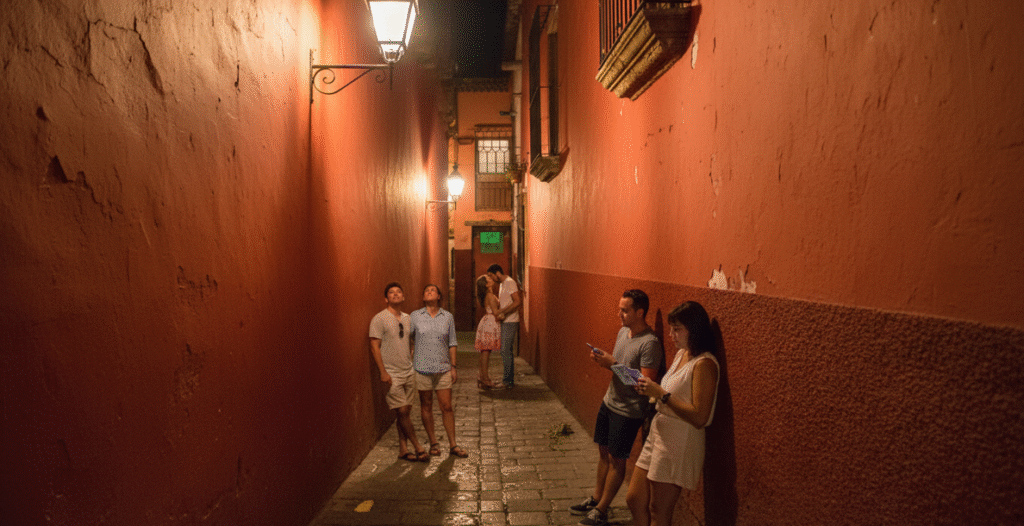
Romantic Night at Callejón del Beso | official price Callejón del Beso
Callejoneada walking tours combine live Spanish music with stories, legends, and local anecdotes at around $8 USD. These tours stop at Callejón del Beso as one destination among several, providing cultural context you wouldn’t get independently. For more information about cultural walking tours in Guanajuato, check the official Visit Mexico tourism portal.
Tours work better for travelers interested in deeper cultural immersion, those who enjoy guided experiences with storytelling, visitors without strong Spanish language skills who want translation help, and people creating an evening activity rather than a quick daytime stop. The entertainment value justifies the cost when viewed as a complete experience rather than just transportation to the alley.
Evening Callejoneadas create festive atmosphere. Musicians use guitar, bandurria, pandero, double bass, and sometimes accordion Peek while leading groups through historic neighborhoods. This transforms the alley visit from photo-op to performance art.
Consider your travel style. Solo explorers who prefer flexibility and spontaneity often choose independent visits. Couples seeking romantic structured experiences might prefer the tour’s built-in atmosphere. Families with children who need entertainment beyond walking fit tours better. Cultural enthusiasts wanting maximum context benefit from guide narration.
Beyond the Basics: Understanding What Makes This Special
The architectural accident that created this space matters more than the romantic legend. Spanish colonizers discovered silver in Guanajuato’s mountains during the 16th century. Wealth poured in. Everyone wanted to build in the narrow valley’s limited flat space.
Normal city planning rules broke down. Houses went up wherever physical space existed, without consideration for streets, views, or neighbors. The result: buildings so close their balconies nearly touch, creating dozens of passages where people on opposite balconies could easily communicate. Callejón del Beso represents just the most famous example of a pattern repeated throughout the city.
The legend exists because the architecture made such stories possible. In local legend, a wealthy family’s daughter fell in love with a common miner, forbidden to see each other, but the miner rented a room opposite and the lovers exchanged furtive kisses from these balconies until the romance was discovered and the couple met a tragic end.
Similar stories probably played out across many of Guanajuato’s compressed passages during the colonial period. Class barriers, arranged marriages, and forbidden love created real-world versions of Romeo and Juliet throughout Latin America. This alley’s legend captured one version of a widespread experience.
The seven-year luck tradition emerged more recently, probably in the 20th century as tourism developed. Earlier versions of the legend focused on the tragic love story without the superstitious element. Modern additions like the painted red third step and specific kissing instructions arose to create clear photo opportunities for visitors. You can explore more about Guanajuato’s UNESCO heritage status and historical significance through the World Heritage Centre.
The Bottom Line on Callejón del Beso Pricing
Understanding the official price Callejón del Beso comes down to one simple fact: the landmark itself is free with no tickets or mandatory guides. Everything else—professional photography services, souvenirs, guided tour experiences—is optional. Budget $0 for entry, $3-6 if you want professional photos, $30-150 if you’re buying souvenirs, or $8 if you prefer a guided Callejoneada tour that includes the alley among multiple stops.
Visit Tuesday or Wednesday before 9 AM to avoid crowds. Plan 15-30 minutes for the alley itself. Walk the surrounding blocks to understand the architectural context. Bring cash for optional purchases. Wear shoes with good traction for stone steps.
The truth that changes everything: You control all costs here. No entrance fees exist. No admission charge applies. Nothing is mandatory except showing up.