
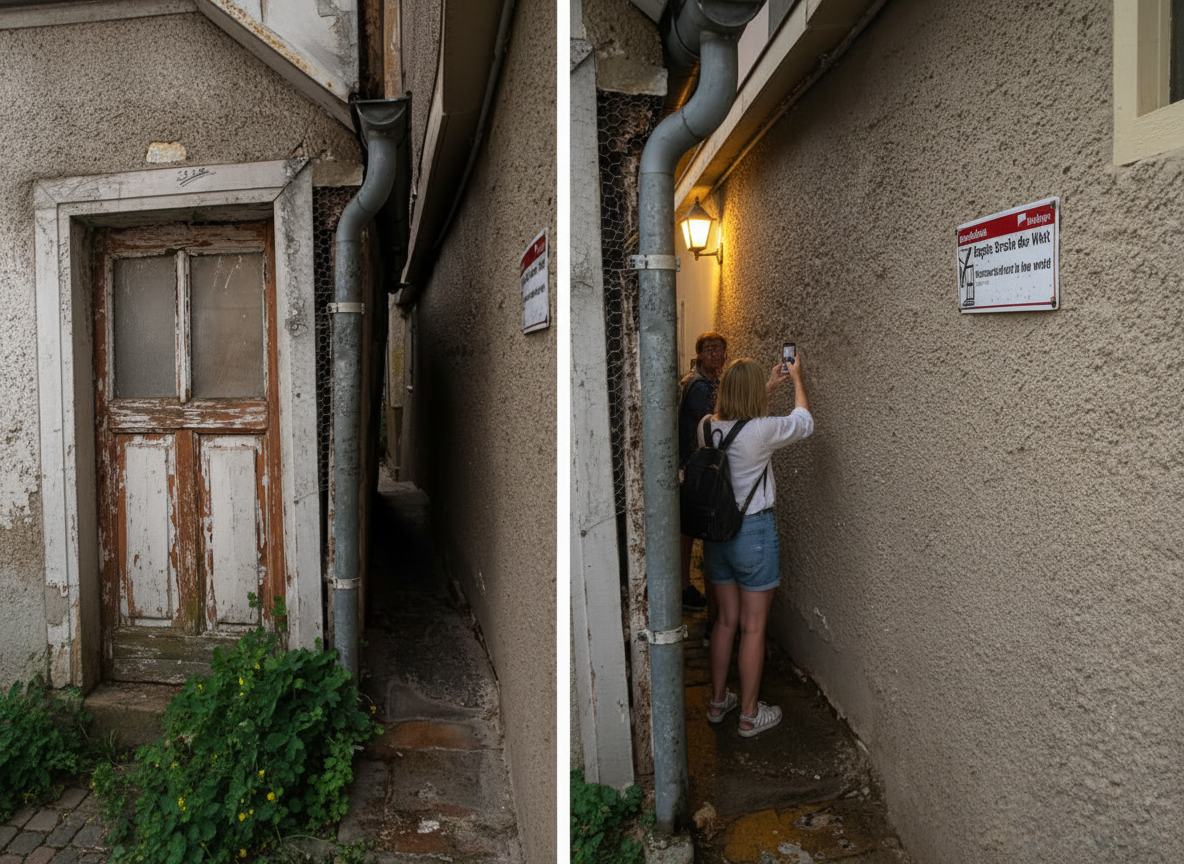
Imagine squeezing through a passage where both your shoulders touch the walls. The narrowest street in the world measures just 31 centimeters—barely wider than a ruler. These ultra-narrow lanes exist across the globe, from Germany to China. Some measure narrower than a laptop screen. They tell stories about medieval city planning, catastrophic fires, and the lengths people went to maximize every inch of urban space.
When searching for the smallest street in the world, you’ll find passages that require turning sideways, traffic lights for pedestrian control, and corridors where two people cannot pass simultaneously. This guide covers the top 5 narrowest streets globally, with practical visiting information, historical context, and honest assessments of what makes each passage worth your time.
More about Callejon del Beso:
- Callejon del Beso Tours
- The Alley of the Kiss (Callejon del Beso): Everything You Need to Know About Guanajuato’s Most Romantic Landmark
What Makes Spreuerhofstraße the Narrowest Street in the World?
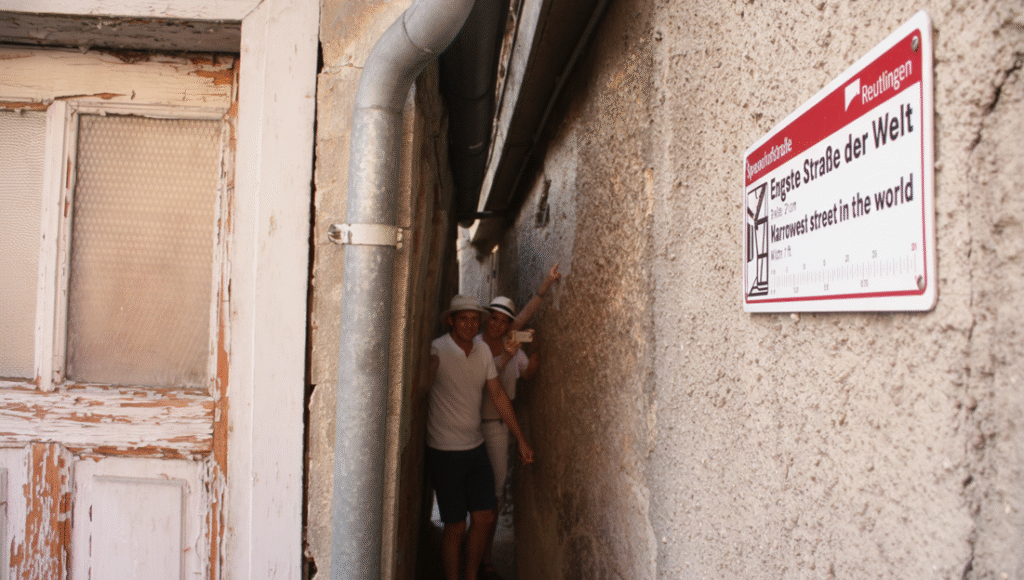
Spreuerhofstraße: The Narrowest Street in the World – Reutlingen
Spreuerhofstraße in Reutlingen, Germany holds the Guinness World Record as the narrowest street on Earth at 31 centimeters (12.2 inches) wide at its tightest point. That’s barely the width of a sheet of printer paper turned sideways.
The tiny passage emerged in 1727 after a devastating fire in 1726 destroyed 80% of Reutlingen’s buildings, leaving 7,000 people homeless. When rebuilding began, land was scarce and expensive. Property owners built as close together as physically possible.
Here’s what actually happens: you turn sideways, suck in your stomach, and shuffle through 3.8 meters of space. The passage is accessible 24/7 with free admission. According to the official Reutlingen tourism site, visitors can find this tight alley at Spreuerhofstraße 57, just off Hauptstraße in the old town.
The catch? One neighboring building has structural issues, creating obstructions that require visitors to crouch. City authorities face a dilemma—repairs that make the building safer would widen the alley and void the world record.
“The half-timbered building keeps sagging. Reutlingen props it up rather than demolishing it. Remove the building and the passage becomes too wide to hold the record. This tiny lane title generates thousands of tourist visits annually to an otherwise unremarkable German town.”
Access: Free, 24/7. Located at Spreuerhofstraße 57, Reutlingen. More info at visitreutlingen.de.
What is the Narrowest Street in the World According to Official Records?
Spreuerhofstraße in Reutlingen, Germany officially holds the title as the narrowest street in the world at 31 centimeters wide, certified by Guinness World Records. While France’s L’Androuno measures 29 centimeters, it lacks official certification, leaving the German passage as the recognized record holder.
The distinction matters for visitors planning routes. Spreuerhofstraße guarantees the verified experience of navigating the world’s tightest documented urban passage. The 31-centimeter measurement appears at the tightest point—most of the 3.8-meter length ranges between 40-50 centimeters.
Three factors secured Reutlingen’s official status: consistent measurements verified by independent surveyors, continuous public access since 1727, and formal recognition as a street rather than a private alley. L’Androuno, despite being narrower, faces classification debates about whether defensive gaps qualify as true streets.
L’Androuno: France’s 29-Centimeter Contender
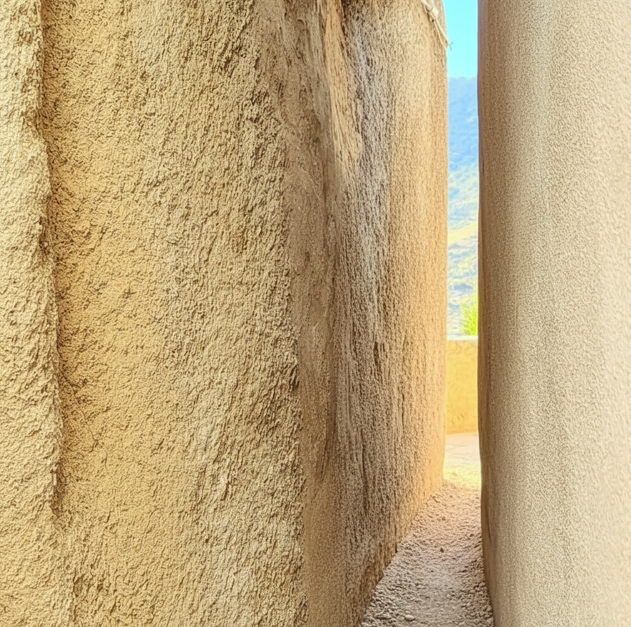
Top 5 The Narrowest Street in the World – Earthen Walls
France claims its own champion among narrow passages. L’Androuno in the hilltop village of Gassin measures 29 centimeters (11.4 inches) at its narrowest point. That’s 2 centimeters narrower than Germany’s record holder.
Most travelers asking “where is the smallest street in the world” discover Gassin only after visiting Reutlingen. The Provençal village sits 90 minutes from Nice, accessible via winding mountain roads that discourage casual visits. This remoteness preserves authenticity—you won’t face crowds blocking the passage.
The original purpose? Defense. The narrow gap prevented armored knights, horses, and siege equipment from penetrating the village while allowing defenders to move quickly. It simultaneously served as drainage during heavy rainfall.
Why doesn’t this hold the official title? Multiple French sources recognize it as an extremely tight lane, but it lacks Guinness certification. The debate between local measurements and official records continues.
Walking through requires turning sideways as your only option. Even children struggle with the 29-centimeter width. Two people cannot pass simultaneously—one must exit completely before the other enters.
Access: Free. Located in Gassin village center, Provence.
Where is Parliament Street Among the Narrowest Streets?
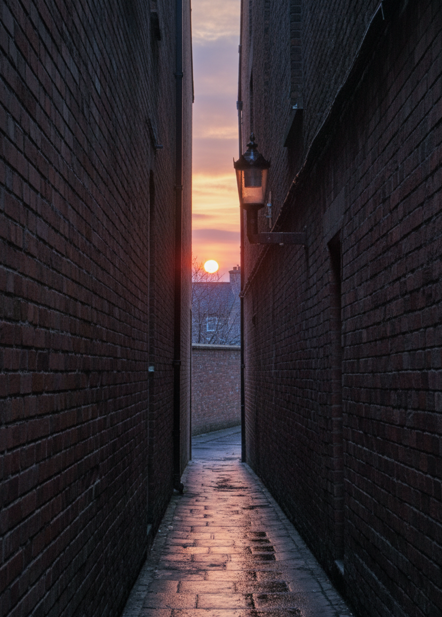
Narrowest Street Alley Sunset Reflection – Moody City Passage
Parliament Street in Exeter measures 64 centimeters (25 inches) at its narrowest point and 122 centimeters (48 inches) at its widest, stretching 50 meters long. The passageway dates to the 14th century.
Originally called Small Lane, it was renamed when Parliament was derided by Exeter’s city council for passing the 1832 Reform Bill. The Reform Bill stripped working men of voting rights. Exeter’s retaliation? Naming its most insignificant lane after Parliament.
This political protest explains why Parliament Street remains Exeter’s most photographed medieval feature. The name transformed an unremarkable service corridor into a statement about governmental overreach—a concept that resonates with modern visitors navigating bureaucratic frustrations.
The medieval reality was grim. Until the 1700s, residents emptied chamber pots into the passage, creating such unbearable odors that in 1740 the City Chamber ordered doors installed at both ends to seal in the stench.
In 1836, Waterbeer Street residents raised £130 to widen this tight alleyway. The work never happened. The lane remains exactly as narrow as it was 600 years ago.
Access: Free, 24/7. Located between High Street and Waterbeer Street, Exeter. More details at exeter.gov.uk.
How Did Beijing’s Qianshi Hutong Become So Tight?
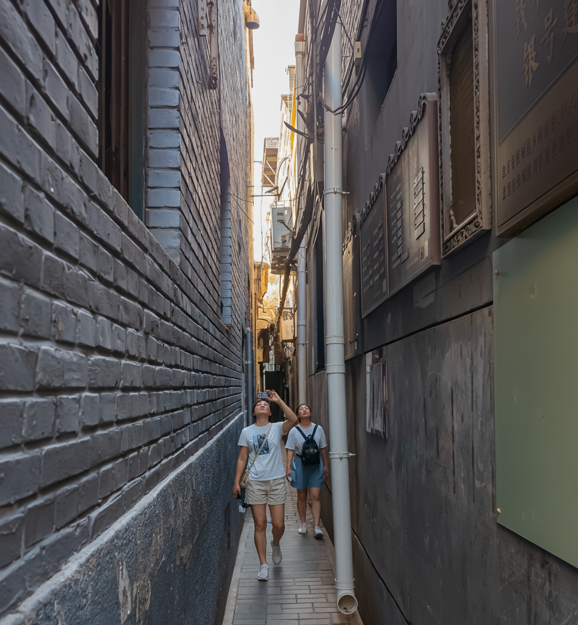
Tourists Exploring a Top 5 The Narrowest Street in the World – Urban Alley
Qianshi Hutong in Beijing’s Dongcheng district measures 40 centimeters (16 inches) at its narrowest point. The 55-meter corridor requires sideways shuffling for most of its length.
The name translates to “money market hutong” for good reason. During the Qing Dynasty, this tight passage housed 26 mints producing copper coins for nearly every bank in the city. Each morning, merchants gathered here to exchange coins for silver taels.
Among the thinnest roads in the world, Qianshi Hutong stands out for preserving active residential life. Unlike European passages that became pure tourist attractions, this Beijing alley functions as actual infrastructure for local families. Morning routines include elderly residents carrying groceries sideways through the 40-centimeter gap—a daily exercise that would exhaust most tourists after one attempt.
Why so narrow? The banks expanded. As financial institutions grew their operations, they encroached on the public pathway until it became Beijing’s tightest squeeze. The width represents exactly what remained after property owners maximized their buildable space.
After 1949, monetary reforms eliminated the alley’s financial function. Today, approximately 10 households occupy this historic corridor. Nearly every resident keeps a fire extinguisher within reach. In a space this tight, fire evacuation becomes life-or-death.
Access: Free. Located in Dongcheng district, Beijing.
Vinárna Čertovka: The Narrow Street with Traffic Control
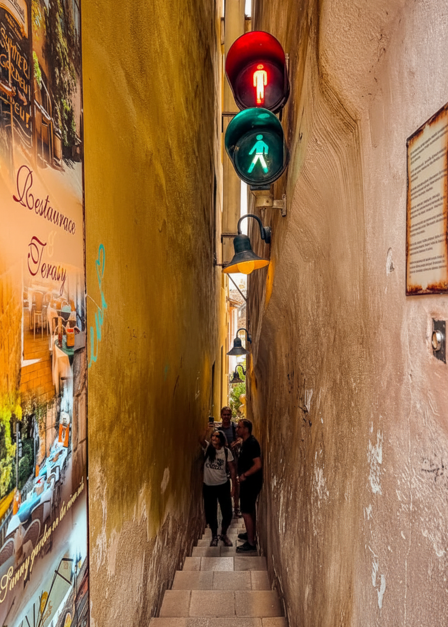
Vinárna Čertovka: One of the Narrowest Street in the World
Prague’s slimmest passage measures 70 centimeters (27.5 inches) wide at its tightest point. What makes it unique? It’s the world’s only ultra-narrow lane with pedestrian traffic lights.
This corridor was designed as a medieval fire escape. The alley connected buildings to the Vltava River so fire brigades could access water quickly during blazes.
The traffic lights aren’t decoration. When the light shows green, you descend. Red means wait. A button at each end lets you signal your intention to pass. The system exists because two people from opposite directions physically cannot squeeze past each other.
The surprise? The passage dead-ends at a staircase leading only to a restaurant. Many visitors feel tricked after navigating the traffic-controlled corridor. But the experience of using pedestrian signals in a 70-centimeter space remains uniquely Prague.
Access: Free, 24/7. Located in Mala Strana district, Prague.
What Historical Pattern Connects These Narrow Streets?
Look at the construction dates. Most originated between 1300-1800, an era when:
- Urban land commanded premium prices
- Fire posed constant danger
- Defensive architecture determined city layouts
- Building codes didn’t exist
Medieval cities built upward and inward. Property owners expanded wherever possible. Corridors that once provided reasonable access gradually tightened as structures grew. Some served specific emergency functions. Others narrowed as commercial enterprises expanded into public space.
The Three Biggest Tourist Mistakes
Mistake 1: Visiting after meals or wearing bulky clothing
People do this because they don’t consider the physical dimensions before arriving.
The cost: At 31-50 centimeters, these tight passages require turning sideways and minimizing body width. After lunch, you might genuinely become stuck. Bulky jackets add 10-15 centimeters to your profile. In a 31-centimeter space, that jacket prevents passage entirely. You’ll need to remove it, carry it in front, and still might not fit.
Result: Wasted time, potential embarrassment, and zero photos from inside the lane.
Mistake 2: Arriving during peak hours without checking crowd levels
People do this because guidebooks list these as “must-see” attractions without mentioning wait times.
The cost: In Prague, you might wait 15-20 minutes for the traffic light system to clear pedestrians. In Reutlingen, encountering someone from the opposite direction means one person must back out entirely—no passing room exists.
Result: You waste 30-45 minutes queuing to shuffle through a 3-4 meter alley. That’s time you could spend at actual attractions rather than standing in line for a novelty.
Mistake 3: Bringing backpacks, strollers, or large bags
People do this because they don’t research actual dimensions beforehand.
The cost: A standard backpack adds 15-20 centimeters to your width. In a 31-centimeter passage, basic math prevents entry. Some ultra-thin lanes explicitly ban large items. Strollers and rolling luggage? Completely impossible.
Result: You turn around at the entrance having learned nothing except that 31 centimeters is narrower than you imagined.
“I photograph tight alleys across Europe. Visit early morning before 9 AM or late afternoon after 5 PM. You’ll avoid crowds, get better light, and actually enjoy the experience instead of queuing. Wear form-fitting clothes—loose garments snag on stone walls. Leave backpacks at your hotel.”
Assuming All Narrow Streets Offer Similar Experiences
People do this because guidebooks group these passages together without distinguishing their unique characteristics.
The cost: You allocate equal time to each location, missing that some offer 30-second novelties while others provide 15-minute explorations with historical context. Spreuerhofstraße requires 5 minutes total (including photos). Parliament Street, with its 50-meter length and Reform Bill history, deserves 20-25 minutes to appreciate properly. Beijing’s Qianshi Hutong benefits from 30-40 minutes exploring the surrounding hutong network and understanding mint heritage.
Price of this mistake: You rush through Parliament Street in 5 minutes, leaving no time to read historical plaques or understand the political satire. You then spend 25 minutes at Spreuerhofstraße waiting for crowds to clear for photos of a 3.8-meter passage. Result: misallocated time that inverts the actual value proposition of each location.
Solution: Research which passages offer historical depth (Parliament Street, Qianshi Hutong) versus pure dimensional novelty (Spreuerhofstraße, L’Androuno). Allocate time proportionally to contextual richness, not narrowness metrics.
Comparing Dimensions and Best Uses of the Narrowest Streets
| Street | Location | Width | Length | Access | Best For |
| Spreuerhofstraße | Reutlingen, Germany | 31-50 cm | 3.8 m | Free, 24/7 | Record holder |
| L’Androuno | Gassin, France | 29 cm | Short | Free, 24/7 | Defensive history |
| Parliament Street | Exeter, UK | 64-122 cm | 50 m | Free, 24/7 | Medieval architecture |
| Qianshi Hutong | Beijing, China | 40-70 cm | 55 m | Free, 24/7 | Financial heritage |
| Vinárna Čertovka | Prague, Czech Republic | 70 cm | Short | Free, 24/7 | Traffic lights novelty |
The Most Narrow Streets: How Width Actually Affects Your Experience
The most narrow street doesn’t automatically provide the best experience—passage length, crowd levels, and surrounding context matter equally. A 31-centimeter corridor stretching 50 meters creates claustrophobia. A 31-centimeter gap spanning 3.8 meters feels like a brief novelty.
Consider three scenarios:
- Width vs. Length Trade-off: Spreuerhofstraße at 31 centimeters × 3.8 meters requires 8-12 seconds of sideways shuffling. Parliament Street at 64 centimeters × 50 meters demands two full minutes of careful navigation. The wider passage feels more restrictive because duration amplifies discomfort.
- Crowd Density Impact: Vinárna Čertovka’s 70-centimeter width accommodates tourist flow via traffic lights. Qianshi Hutong’s 40-centimeter width with 10 residential households creates bottlenecks when locals need access during peak tourist hours.
- Surrounding Architecture: Beijing’s hutong walls reach 4 meters high, creating a canyon effect. Gassin’s L’Androuno measures 3 meters tall, allowing sunlight to penetrate. The psychological experience differs dramatically despite similar widths.
The tightest passage isn’t always the most memorable. Prague’s traffic light system, Parliament Street’s 600-year history, or Qianshi Hutong’s mint legacy often leave stronger impressions than pure narrowness.
Looking at the Downside: When Narrow Streets Create Problems
These tight lanes make excellent tourist attractions but terrible actual infrastructure. Residents face challenges guidebooks ignore.
Emergency access becomes nearly impossible. Fire trucks cannot reach properties accessed through 40-centimeter corridors. Medical emergencies require paramedics to carry equipment while shuffling sideways. Think of it like trying to move a couch through a doorway—except the doorway is your only exit, you can’t remove the door, and someone’s life depends on speed. Around 10 Qianshi Hutong households keep fire extinguishers because the narrow width prevents safe evacuation during fires.
In 2023, a medical emergency in Qianshi Hutong required responders to carry a stretcher vertically through the passage, adding 12 critical minutes to response time. The patient survived, but the incident highlighted infrastructure problems that tourism websites never mention.
Delivery services won’t operate. Try ordering furniture, appliances, or grocery delivery when the access point measures 40 centimeters wide. Residents either live with existing items or devise creative solutions involving ropes, pulleys, and considerable patience.
Tourist crowds cause constant disruption. Imagine exiting your home when 50 visitors queue outside taking selfies and blocking your only exit. Residents near Parliament Street and Vinárna Čertovka deal with this daily during tourist season.
For whom might these disappoint? Anyone with mobility limitations, claustrophobia, or above-average physical size. Wheelchairs, crutches, and walkers cannot navigate these spaces. Tight spaces triggering anxiety transform the experience from fun into stress. And if you’re physically larger than average in any dimension, you literally might not fit.
Why These Tiny Passages Matter Beyond Tourism Clicks
The smallest roads in the world preserve what modern cities lost—the physical reality of pre-industrial urban density and the economic pressures that shaped it. Beyond Instagram photo opportunities, these passages document how societies prioritized property rights over public space.
- Economic archaeology: Each centimeter of width tells a story about land values. In post-fire Reutlingen (1727), rebuilding costs were so extreme that property owners built walls 31 centimeters apart to maximize rentable space. That single measurement reveals more about 18th-century German economics than pages of tax records.
- Legal precedents: Parliament Street’s continued existence demonstrates how naming rights and historical designation can protect infrastructure that modern codes would demolish. The passage survives because removing it would erase political satire embedded in city records since 1832.
- Cultural priorities: Beijing preserved Qianshi Hutong while demolishing thousands of similar corridors during modernization. The decision reflected what heritage authorities valued—financial history over residential architecture. That choice shapes which historical narratives survive for future generations.
Walk through these passages not just to experience narrowness, but to understand the economic, legal, and cultural forces that created them. The squeeze between walls is temporary. The historical insight lasts.
How Did Tourist Novelties Replace Functional Streets?
Twenty years ago, most of these existed as local oddities. Strada Sforii was a Brașov shortcut. Fan Tan Alley was slightly shady. Qianshi Hutong was simply another Beijing corridor residents used daily.
Social media changed everything. Between 2010-2015, as Instagram and travel blogs exploded, these tight passageways became “hidden gems” and “secret spots.” Prague’s lane installed traffic lights partly for crowd control, partly as marketing genius. The installation went viral, transforming a forgotten fire escape into a must-see attraction.
Reutlingen’s city council faced a decision when their half-timbered building started leaning. Demolish it and lose the record, or prop it up and maintain tourist interest. They chose preservation—not for historical value, but for economic impact. The world’s narrowest street brings thousands of visitors annually to an otherwise unremarkable German town.
What could have happened instead? Many medieval cities had dozens of such corridors. Most were widened during modernization to improve traffic flow and emergency access. Prague once had multiple fire escape alleys—only one survived. Beijing had countless narrow hutongs—urban renewal demolished the majority.
If Instagram hadn’t elevated these spaces, they’d likely have been modernized or disappeared entirely. Their current status directly influences today’s experience—they exist as preserved curiosities rather than functional infrastructure, maintained specifically because tourists want to see them.
Practical Visitor Information
- Timing: Visit before 9 AM or after 5 PM to avoid peak crowds. Weekdays see significantly less traffic than weekends. For Spreuerhofstraße and L’Androuno specifically, early morning visits (7-8 AM) provide empty passages—the difference between waiting 15 minutes versus walking straight through.
- Clothing: Wear form-fitting clothes without bulky jackets or protruding pockets. Leave backpacks and large bags at accommodation. A simple test: if you can’t comfortably reach both arms straight out sideways in your outfit, it’s too bulky for 31-centimeter passages.
- Photography: Wide-angle lenses exaggerate narrowness. Standard smartphone cameras better represent true perspective.
- Accessibility: None accommodate wheelchairs, strollers, or mobility aids. All require walking and sideways movement.
- Safety: Check weather forecasts. Rain makes stone steps slippery in Prague and Stockholm. Avoid winter ice conditions.
- Time required: Budget 5-15 minutes per lane, plus potential queue time of 10-30 minutes during peak hours.
- Context: Most passages sit in historic districts with other attractions. Don’t make the slim corridor your sole destination—it’s a five-minute experience, not a half-day activity.
- Local etiquette: Residents use some tight alleys as actual access routes. Give locals priority. Don’t block corridors for extended photo sessions.
What These Passages Reveal About Urban Evolution
These narrow streets preserve what modern cities lost—the physical reality of pre-industrial urban density. Before zoning laws, building codes, and fire regulations, cities grew organically based on property boundaries and immediate needs.
Qianshi Hutong’s 70-centimeter width wasn’t arbitrary. It represented the exact space remaining after banks expanded to their property lines. Spreuerhofstraße’s 31 centimeters emerged from post-fire reconstruction when every centimeter of buildable space mattered for housing survivors.
Walking through connects you to historical reality in ways photos cannot. Your shoulders touching walls on both sides, your sideways shuffle, the claustrophobic awareness of surrounding stone—this was daily life for medieval urban residents.
Modern building codes prohibit such construction. Fire safety regulations require minimum clearances. Accessibility laws mandate wheelchair access. These slim passages couldn’t be built today, making their preservation both valuable and problematic.
They exist in tension between roles as living infrastructure and historical artifacts. Some, like Fan Tan Alley, successfully transformed into commercial spaces. Others, like Spreuerhofstraße, serve no practical purpose beyond tourism.
These aren’t just tight lanes. They’re architectural time capsules, each preserving moments when space was scarce, rules were different, and “street” included corridors that modern planners would classify as safety hazards.
When you search “top 5 narrowest streets in the world,” you’re not just looking for dimensional curiosities—you’re seeking tangible connections to how humans adapted to constraints. These passages prove that sometimes the smallest spaces tell the biggest stories about how we build, live, and preserve our urban heritage.
These aren’t just tight lanes. They’re architectural time capsules, each preserving moments when space was scarce, rules were different, and “street” included corridors that modern planners would classify as safety hazards.For more information on visiting these historic narrow passages, consult official tourism websites: Reutlingen Tourism, Exeter Official Guide, and Prague Tourism.